
Energy-Efficient Patio Doors for New England Winters: A Malden Buyer’s Guide
A patio door is mostly glass, and glass is a poor insulator, so it loses much more heat than a solid entry door and often more than the windows around it. The Department of Energy is blunt about it: single-pane and sliding glass patio doors lose far more heat than other door types (DOE Energy Saver, Doors, archived June 2026). On a Malden triple-decker’s back porch or a Maplewood cape with a slider onto the deck, that door is often the coldest spot in the room come February. This guide is about spec’ing one that holds heat: the glass package, the label numbers, the operating style, and the part most buyers miss, the seal.
The bottom line
The short version, every claim sourced:
- A patio door is mostly glass, so the glass package (panes, low-E, gas fill, warm-edge spacer) drives most of its energy performance (DOE Energy Saver, Doors, archived June 2026).
- Look for ENERGY STAR certification for the Northern climate zone, which holds a full-glass slider to the same bar as a good window (ENERGY STAR).
- A swinging (French) door generally seals tighter than a slider, and a slider’s air leakage cannot be fully eliminated while it still opens (DOE Energy Saver, Doors, archived June 2026).
- The install, weatherstrip, and sill seal decide the real-world result, not just the door’s label rating.
- We put the glass package and the U-factor in writing before you sign.
Why is a patio door a bigger heat leak than a window?
A patio door is a large, mostly glass, operable panel, so it loses more heat than a window over the same wall, and the glass and seal drive its performance. Per the DOE, single-pane and sliding glass doors lose much more heat than other door types because glass is a poor insulator (DOE Energy Saver, Doors, archived June 2026). A solid steel or fiberglass entry door has an insulated core. A patio door does not.
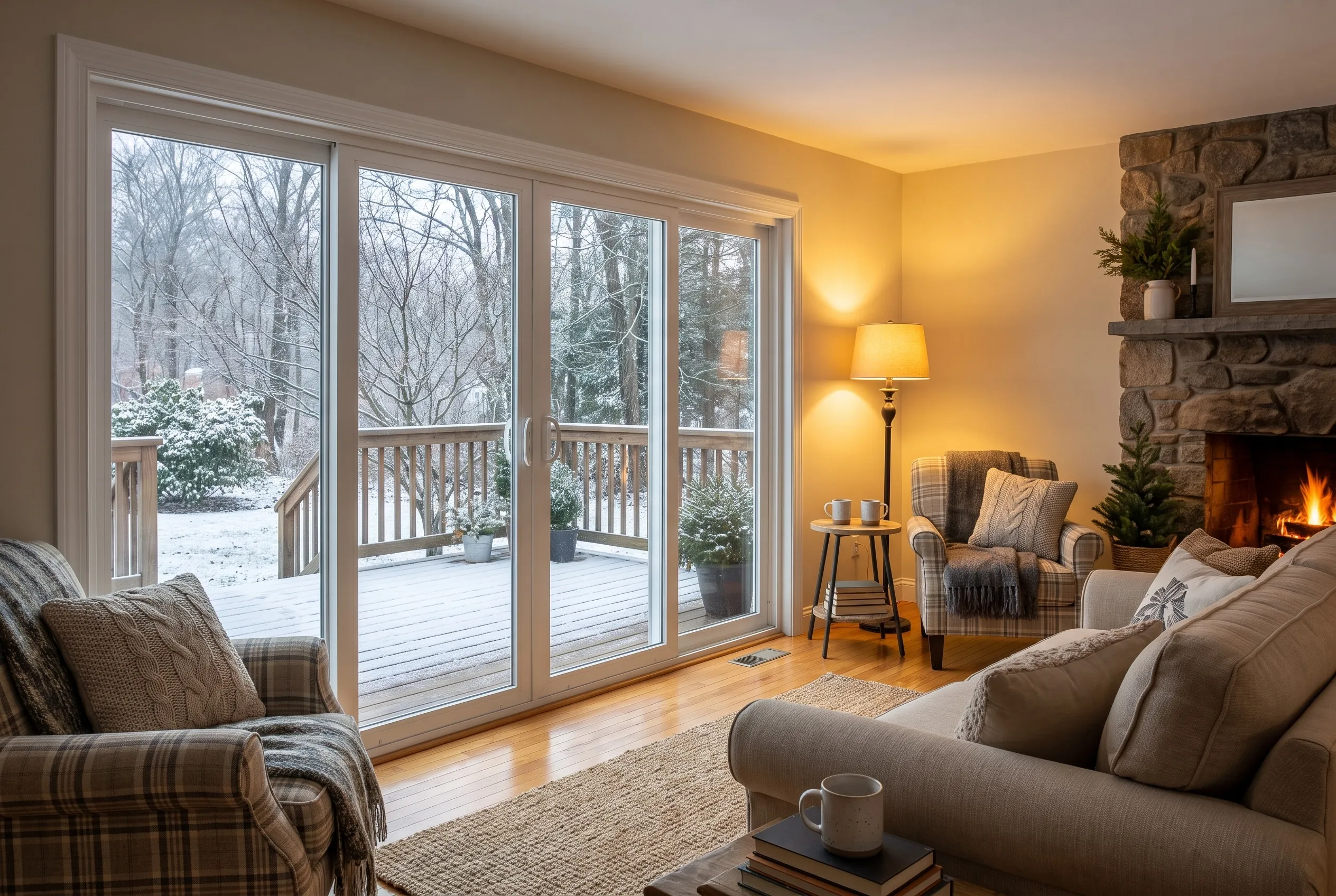
That changes where you spend your attention. On a window in a wall, the frame and surrounding wall carry a lot of the insulating work. On a patio door, the glass is the wall. A six-foot slider off a Linden ranch or a Maplewood cape’s deck is a sheet of glass you can walk through, so anything the glass package does wrong shows up as a draft you feel across the room.
The rating math behind U-factor, SHGC, and low-E is the same for a door as for a window, and we do not re-teach it here. For the foundational primer on how those numbers work, our energy-efficient windows guide for cold-climate Malden homes walks through it in detail. This post stays on the door-specific problems: the large glass area, the slider track, and the sill.
How do you read the NFRC label on a patio door?
The NFRC label is the independent, apples-to-apples spec sheet for any glass door. The NFRC is a nonprofit body that rates the energy performance of windows, doors, and skylights, and its label reports U-factor, solar heat gain coefficient (SHGC), visible transmittance, and air leakage (NFRC). Two numbers matter most on a cold-climate door.
U-factor measures heat loss. Lower is better at keeping your furnace’s heat inside. SHGC measures the share of the sun’s heat the glass lets in. Here is the New England twist: in the Northern climate zone, you want enough solar gain to help offset the furnace on a clear winter day, so the standard sets a minimum SHGC, not just a maximum.
ENERGY STAR certification is the shortcut. Products earn it by meeting U-factor and, where applicable, SHGC requirements set by climate zone, all based on NFRC-certified ratings, under performance levels effective October 23, 2023 (ENERGY STAR). Separate criteria exist for windows, doors, and skylights (ENERGY STAR Key Product Criteria). A full-glass slider is held to the same Northern-zone bar as a window, so a good full-lite unit should clear roughly the same 0.22 U-factor and 0.17 SHGC targets a strong Northern-zone window meets.
Why is the glass package most of the door?
Because the glass area is so large, the glass package moves the number more on a patio door than on a small window. The DOE recommends glass doors with several layers of glass, low-emissivity (low-E) coatings, and low-conductivity gas fills between the panes as a good investment (DOE Energy Saver, Doors, archived June 2026). On a door that is almost entirely glass, that is not a trim upgrade. It is the product.
Four things make up a cold-climate glass package. Double or triple glazing puts two or three panes between you and the January air. A low-E coating reflects heat back into the room while still letting light through. An argon or other low-conductivity gas fill slows heat transfer between panes. And a warm-edge spacer, the strip holding the panes apart at the edge, cuts the cold bridge around the perimeter where drafts tend to start.
On a small bathroom window, skimping on the glass package costs you a little. On a wide slider, it costs you the whole room. So read the glass spec closely and get it in writing.
A cold-climate glass package has four parts:
- Double or triple glazing: two or three panes between you and the January air.
- Low-E coating: reflects heat back into the room while still letting light through.
- Argon (low-conductivity gas) fill: slows heat transfer between the panes.
- Warm-edge spacer: cuts the cold bridge around the glass perimeter, where drafts tend to start.
Sliding vs swinging: which one seals tighter?
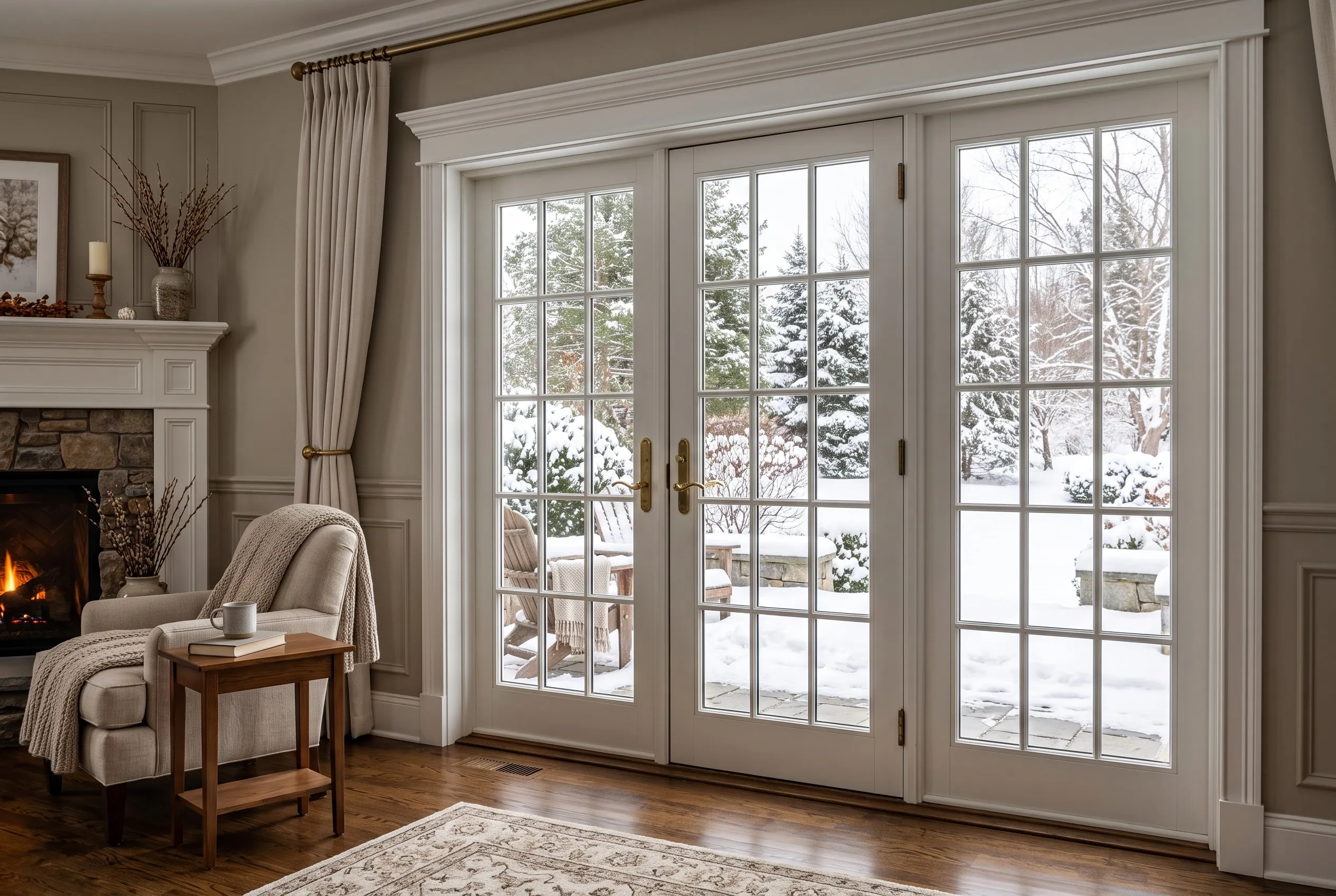
This is the single biggest door-specific efficiency point. Per the DOE, swinging (French) patio doors generally offer a tighter seal than sliding types (DOE Energy Saver, Doors, archived June 2026). A slider seals by pressing weatherstrip against a track. A French door seals by closing a hinged panel tight against a stop, more like a good entry door.
That seal also degrades differently. The DOE notes a slider’s air leakage worsens over time as the weatherstripping wears (DOE Energy Saver, Doors, archived June 2026). If your current slider whistles in a Nor’easter, that is usually a worn track seal, not your imagination.
Multi-slide and telescoping doors stack several large panels to maximize the glass and opening width. That is a real design benefit, but more panels mean more linear feet of seal to keep tight, so it is a trade-off, not a free upgrade. That is the efficiency lens only. For the full use-case comparison, see our sliding vs French patio doors guide for Malden. New Sash installs sliding, French, and multi-slide patio doors and repairs existing ones, so we have no stake in steering you to one style.
How do frame material and panel count affect efficiency?
Frame material affects both the door’s U-factor and how well it holds its seal over years of New England weather. The frame is the part that is not glass, so a low-conductivity material helps the whole unit hold heat, and a well-built frame keeps the door square so the weatherstrip stays tight. Panel count is the other lever: more panels means more glass and more linear feet of seal to maintain.
Match that to your house and exposure. A wide multi-slide on a windy top-floor triple-decker unit or a west-facing Edgeworth colonial wall asks more of its seal than a single slider in a sheltered spot. More seal to keep tight is fine when the install is right, and worth thinking twice about on the most weather-beaten wall of the house. If you are weighing the budget against panel count, our patio door replacement cost guide for Massachusetts breaks down what each configuration tends to run.
Why do installation, weatherstripping, and the sill seal decide the result?
This is the part most buyers miss. A door with a strong label rating still leaks if it is set into an out-of-square, poorly sealed old opening. Per the DOE, weatherstripping reduces air-leakage losses and pre-hung doors come weatherstripped, but that weatherstripping deteriorates and needs periodic inspection (DOE Energy Saver, Doors, archived June 2026). The best glass package in the world does not help if the air is going around the door instead of through it.
A patio door also has a heat-loss path a window never has: the threshold and sill at floor level. Older Malden openings, on Maplewood colonials, Faulkner two-families, and post-war Linden ranches alike, are rarely still plumb and square. If the sill is not sealed and level, cold air pours across the floor no matter what the label says. That is why we measure twice and seal the sill.
It is also the repair-vs-replace fork. A draft from a worn slider seal or a failed threshold can sometimes be a repair, not a new door. New Sash installs all three patio styles and repairs existing patio doors, so we have no reason to push the bigger number when a reseal will do. As Steve Brickman put it in a Google review (2026-05): “The quality and service were first rate, and the price was as quoted. No surprises.”
Get a written quote with the U-factor in writing
Worried about drafts and heat loss from your patio door? Get a free written quote. We install sliding, French, and multi-slide patio doors, repair existing ones, and put the glass package and the U-factor in writing before you sign, with no high-pressure visit. We install year-round across Malden and the Greater Malden area (Medford, Melrose, Everett, and Revere), so winter installs are routine.
The quote you take home is the price you pay. Call (833) 639-7274, email info@newsash.com, or request your free written quote. You can also reach us at 15 Waite Ct., Malden, MA 02148. Ready to start with the full patio-door decision? See our patio door installation overview for Malden, or view the services we offer.
Frequently asked questions
What U-factor should a patio door have in New England?
Aim for a full-glass patio door that meets ENERGY STAR’s Northern climate zone criteria, which is roughly a 0.22 U-factor or lower. Those criteria are based on NFRC-certified ratings, and a full-lite slider is held to the same bar as a window (ENERGY STAR Key Product Criteria). Ask for the NFRC label before you sign.
Are sliding patio doors always drafty?
No, but they seal differently than a swinging door. Per the DOE, swinging (French) doors generally seal tighter than sliders, and a slider’s air leakage cannot be fully eliminated and worsens as the weatherstrip wears (DOE Energy Saver, Doors, archived June 2026). A well-installed slider with fresh weatherstrip and a sealed sill performs well; a worn one drafts.
Is a low-E, argon-filled glass package worth it on a patio door?
Yes, more so than on a small window. The DOE recommends glass doors with several glass layers, low-E coatings, and low-conductivity gas fills as a good investment (DOE Energy Saver, Doors, archived June 2026). Because a patio door is almost all glass, that package drives most of its winter performance, so it moves the needle more here than on a wall window. For the budget side of the decision, see our patio door replacement cost guide for Massachusetts.