
Common Window Problems in Older Malden Homes (and Which Ones Are Actually Fixable)
You see the symptom before you ever think about a quote. Fog trapped between the panes that won’t wipe off. A cold edge by the sash on a windy night. A window that drops shut the second you let go of it. A sash painted into its frame after decades of repaint coats.
This is a plain-language field guide to the window problems we see most in older Malden and Greater Malden area homes (triple-deckers, Maplewood capes, Edgeworth colonials, the two-families out in Everett and Revere). For each symptom, here’s what’s actually happening, whether it’s usually a repair or a replacement, and what we do about it. Honest triage, not a replacement pitch. If you’ve already decided you’re choosing between fixing and replacing, our window repair vs replace guide for the Greater Malden area handles the economics. This post meets you a step earlier, at the symptom.
The Bottom Line
– Most single-window symptoms (a drafty sash, a snapped sash cord, a painted-shut window) are repairs, not replacements, when the frame and sill are sound.
– Fog between the panes means the insulated glass unit lost its seal and moisture got into the sealed space. That one often points to a glass or unit swap, not a whole new window.
– Structural rot into the sill or jamb is the line where replacement enters. Surface rot usually isn’t.
– On any home built before 1978, repairs that disturb paint follow EPA lead-safe practices (EPA RRP rule).
– We tell you the repair option before the replacement option, in writing.
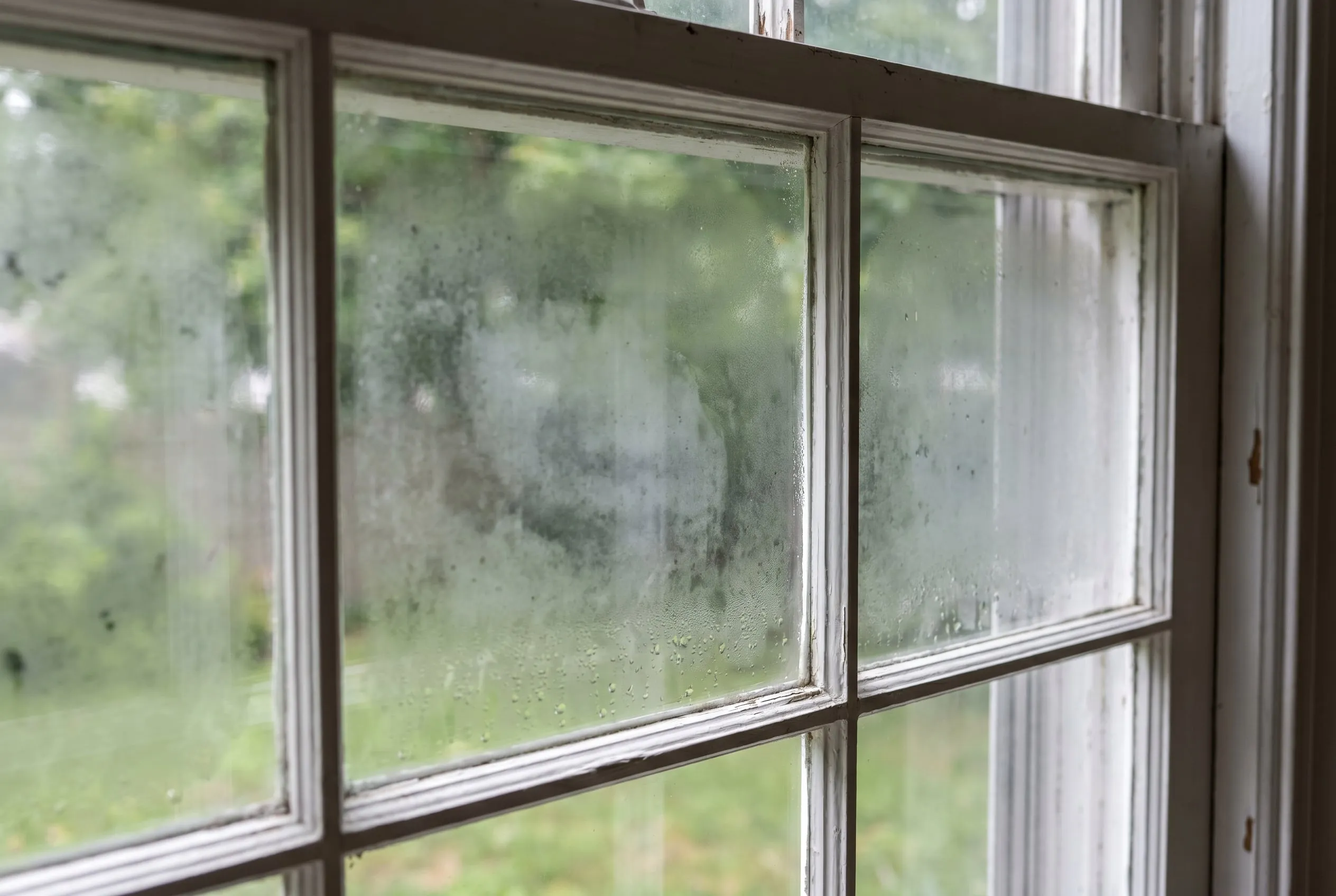
Why are my windows foggy or full of condensation between the panes?
Fog or haze trapped between two panes of glass means the seal on the insulated glass unit has failed, and moisture got inside the sealed space. It will not wipe off, because the moisture is on the inside. That haze is the visible sign the unit has stopped doing its job, even when the rest of the window is perfectly sound.
Here’s what’s going on. A modern window is an insulated glass unit, usually two panes with a gas fill and a coating in the sealed space between them. That seal keeps moisture out and the insulating gas in. When it lets go, you get the telltale haze, and the window stops insulating the way it should. The National Fenestration Rating Council rates a window’s insulating performance (its U-factor) on the label, and that number depends on the sealed gas fill staying put, which is why a failed seal is a real loss, not just a cosmetic one (NFRC).
Is it a repair or a replacement? It depends on the sash. On many older windows with a sound wood sash, the glass unit can be swapped while the frame and trim stay put, which is usually a repair, not a replacement. On most newer vinyl and fiberglass windows, the glass is bonded into the sash, so the practical fix is a new sash or unit. Either way, fogging is a single-window problem with a single-window answer in most cases. When several windows fog at once and the frames are tired, that’s a different conversation, and the repair vs replace guide covers it.
Why is there a cold draft along the edge of my window?
A cold edge or a felt draft on a windy night usually means the weatherstrip, the seal at the meeting rail, or the glazing putty has worn out, not that the whole window is shot. Air leakage around the sash is one of the ratings the National Fenestration Rating Council puts on every window label, and an old sash that has loosened over the decades scores poorly on it (NFRC). The good news: most of that is fixable without pulling the unit.
On an older double-hung, three things let air in. Worn weatherstrip along the sides of the sash. A gap where the top and bottom sash meet in the middle (the meeting rail). And cracked or missing glazing putty around the glass on a wood sash. Each of those is a repair: a strip-and-replace, a new sweep or seal at the meeting rail, a re-glaze. The frame stays in the wall. The U.S. Department of Energy points out that when existing windows are in good condition, sealing and weatherstripping to cut energy loss is worth doing, which is exactly this kind of work (DOE Energy Saver, archived June 2026).
A note for the coast. On Revere two-families and other homes near the water, salt air is hard on the metal parts at the meeting rail and on the hardware. We see more corroded locks and stiffer sash near the shore, which is still usually a hardware-and-seal repair, not a new window. Our Revere window repair page speaks to that housing stock directly.
Why won’t my window stay open, and is that hard to fix?
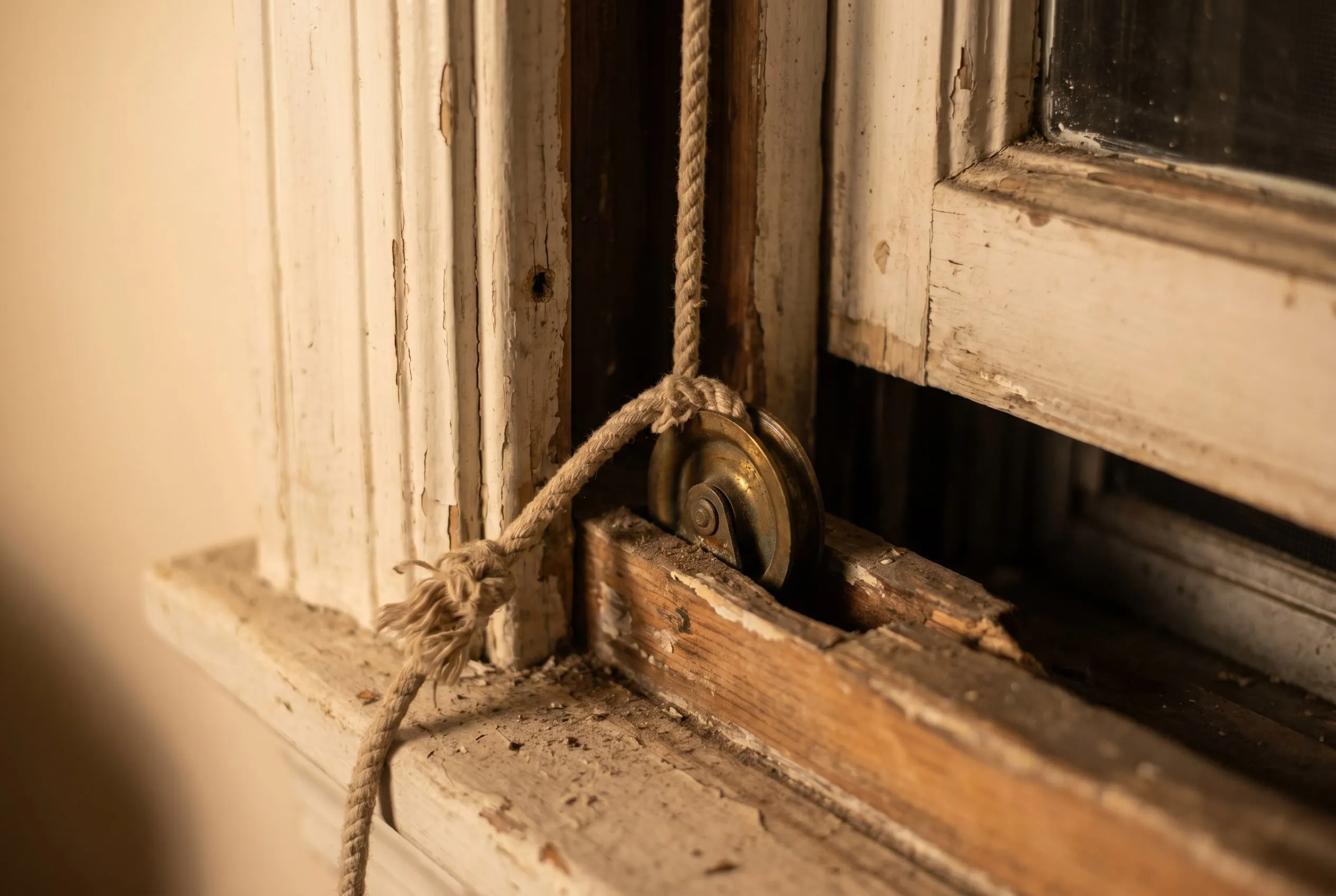
A window that won’t stay up, or one that’s hard to slide at all, almost always points to a broken or worn sash balance, and that’s a repair, not a replacement. On the rope-and-pulley double-hungs common in Malden triple-deckers and colonials, the sash hangs on a cord running over a pulley to a hidden counterweight. When the cord snaps, the sash drops. Replace the cord and the window works again.
Different eras use different balances. The pre-war wood double-hungs use that rope (or chain) and a counterweight tucked in a hollow pocket inside the jamb. Mid-century and later windows use a spiral balance or a block-and-tackle balance instead, a spring mechanism on the side of the sash. All of them wear out. All of them are serviceable parts. The fix is to replace the broken balance and re-seat the sash, which keeps the frame, the trim, and the look from the street.
Why does this matter for an older Malden home? Because from the inside, a snapped sash cord and a “dead” window look identical, but one is a quick part swap and the other is nothing at all. We’ve found that homeowners often assume a window that won’t stay up is done. It rarely is. If you’re in Malden, our Malden window repair page covers the rope-and-pulley specifics for the local housing stock.
Is a painted-shut window or a rotted sill repairable?
A painted-shut sash is almost always a repair, and surface rot on a sill or stop usually is too. The line where replacement enters is structural rot: when the wood is soft and gone deep into the jamb, the sill, or the sash rail itself. The U.S. Department of Energy notes that when existing windows are in good condition, steps to reduce their energy loss can make the home more comfortable without a full replacement (DOE Energy Saver, archived June 2026). “Good condition” is the test, and it’s a frame-and-sill test.
Painted shut is the easy one. Decades of repaint coats glue the sash to the jamb. A careful scoring cut, a paint zipper, and some patience free it, then the sash gets re-balanced so it stays where you put it. No new window required.
Rot is the “it depends” case. Surface rot on the face of a sill or a stop can often be cut out and patched while the structure stays. But when you can sink a screwdriver into the bottom of the sash rail or deep into the sill, and the jamb behind it is wet too, the opening has lost its integrity. Setting a new window into a rotted opening wastes the new window. That’s the one symptom on this list that regularly points to replacement, and we’ll say so in one line rather than argue the math here. The repair vs replace guide has the full framework. Out in Everett, our Everett window repair page speaks to the two-family and triple-decker stock where we see this most.
What does New Sash actually do for each of these problems?
We offer both window installation and window and door repair, handled by the same factory-trained crew, across Malden and the Greater Malden area (Medford, Melrose, Everett, Revere). Because both services pay the same crew, we have no reason to push you toward the bigger number when the smaller one is correct. Where the fix is straightforward, same-day repair is on the table.
Here’s how the diagnosis works. The quote visit is free and the diagnosis is in writing. We measure twice. On any pre-1978 home, we pull at least one interior stop so we can see the actual condition of the sill, jamb, and weight pocket before we put a number on the page. You get a line per opening with the recommended action: repair, replace, or “depends,” with a note on exactly what we need to check. The price you take home is the price you pay.
One thing we don’t compromise on. Most older Malden homes were built before 1978, so any repair that disturbs paint follows lead-safe work practices: containment, HEPA cleanup, and proper waste handling, per the EPA Renovation, Repair and Painting rule (EPA RRP rule). We repair windows to the same standard we install them, not as a maintenance side job. If you want the local “get it fixed” step, our town repair pages for Medford, Revere, and Everett are the next stop.
Frequently asked questions
Can foggy windows really be fixed without replacing the whole window?
Often, yes. Fog means the insulated glass unit lost its seal and moisture got into the sealed space between the panes. On many older wood sash, the glass unit swaps out while the frame stays. On bonded vinyl or fiberglass sash, it’s usually a new sash. We tell you which during the free written diagnosis.
My window won’t stay open. Is that a sign I need new windows?
Usually not. A window that drops shut almost always means a broken sash cord or a worn balance, which is a part you replace while the frame and trim stay put. It’s one of the most common repairs we do on Malden triple-deckers and colonials. Our Malden window repair page covers the rope-and-pulley specifics.
How do I know if a rotted sill is repairable or not?
It comes down to how deep the rot goes. Surface rot on a sill face can often be cut out and patched. Structural rot soft into the jamb and sash rail is where replacement enters, because a new window in a rotted opening fails fast. We check it in person, in writing. The repair vs replace guide walks through the call.
Do you take lead paint precautions on older homes?
Yes. Most older Malden homes predate 1978, so repairs that disturb paint follow lead-safe practices: containment, HEPA cleanup, and proper waste handling, per the EPA Renovation, Repair and Painting rule (EPA RRP rule). We hold to that standard on a repair the same way we do on a full replacement.
See one of these on your own windows?
Most of what shows up on an older Malden window (a draft, a snapped sash cord, a painted-shut sash, one fogged pane) is a repair when the frame is sound, not a full replacement. The symptom tells you a lot. The frame and sill tell you the rest, and that’s a five-minute look in person.
Seeing one of these on your own windows? Get a free written diagnosis. Call (833) 639-7274 or fill out the form. We tell you the repair option before the replacement option, and we respond within 24 hours with no high-pressure visit. New Sash, 15 Waite Ct., Malden, MA 02148, info@newsash.com.