
Sliding Patio Door Problems: When to Repair vs Replace (A Malden Diagnostic)
On a Malden triple-decker, a Faulkner two-family, or a post-war ranch or cape in Linden or Edgeworth, the sliding patio door on the back addition or three-season porch is often the original 1960s to 1980s unit, and it usually fails in one specific way, not all at once. That distinction is the whole decision. Most single-symptom slider problems (rollers, track, weatherstrip, lock, or foggy glass) are repairs when the frame and sill are still sound. Replacement enters in one place: structural rot in the sill or jamb, or a frame racked out of square.
The bottom line
The quick read, symptom by symptom:
- Hard to slide or dragging: almost always a repair. Dirty track or worn rollers, cleaned, adjusted, or swapped. Frame stays.
- Panel jumped the track or feels loose: usually a repair (re-seat and service the rollers). Replacement signal is a track or frame that will not true up.
- Foggy glass between the panes: usually a repair. A failed glass unit is often a panel or glass swap, not a whole new door, if the frame is sound.
- Cold draft along the edge: a repair. Worn weatherstrip, a failed sweep, or a packed brush seal, all serviceable.
- Broken lock or handle, or the door will not latch: a repair. New lock or handle, or a keeper re-alignment.
- Rot in the sill or jamb, or a racked frame: the one that regularly points to replacement.
- Either way, in writing: we give you the repair option before the replacement option, so you are choosing, not being sold.
For the same decision on your windows instead of the slider, see repair vs replace for windows in Greater Malden.
Why won’t my sliding patio door slide (or why is it so hard to open)?
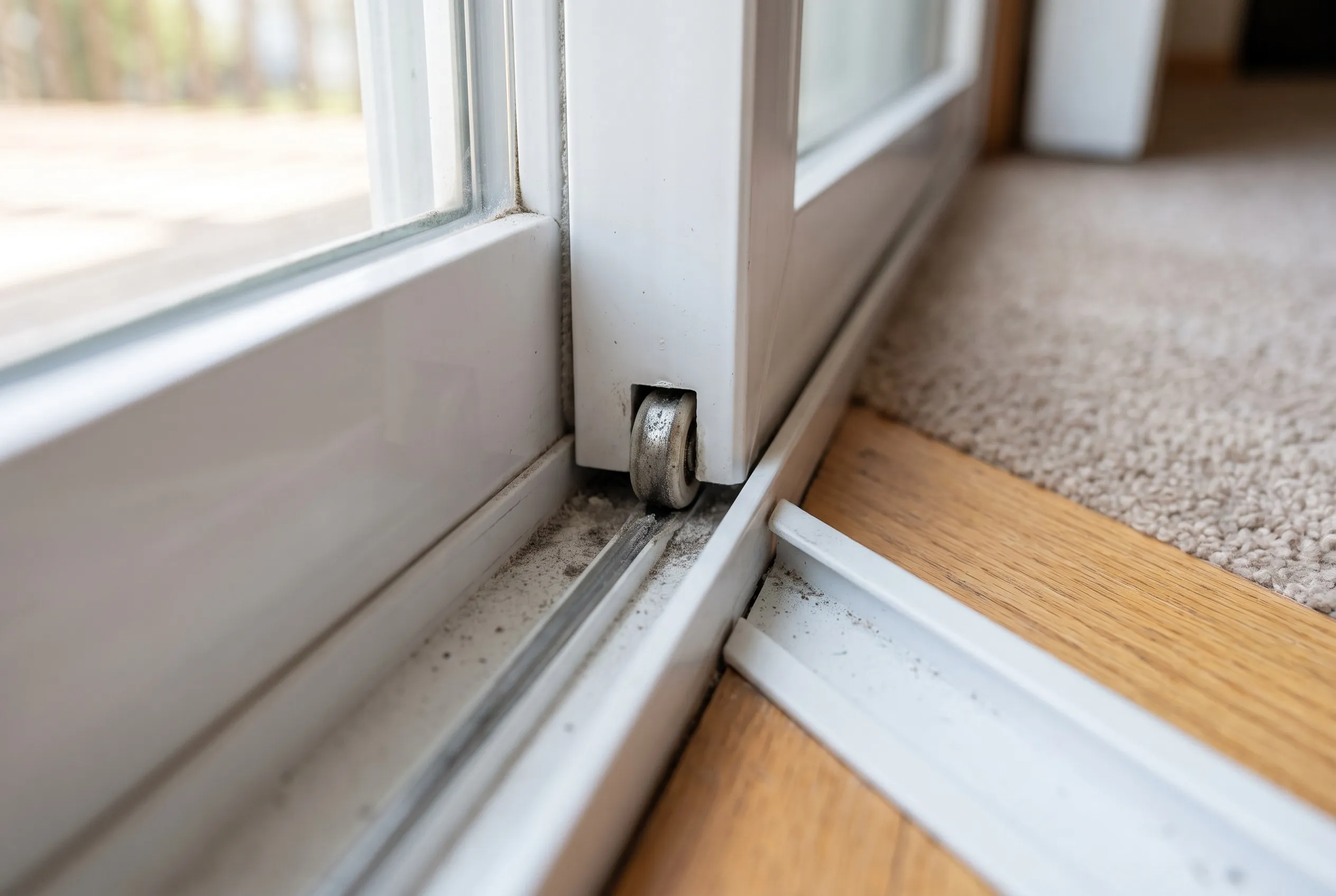
This is the single most common slider complaint we get, and it is almost always a repair. The panel rides on small rollers in the bottom track. Over years, dirt and debris pack into that track, or the rollers flatten, seize, or wear out of round, and the panel drags. The Department of Energy favors repair before replacement here: when the frame is in good condition, servicing what you have is the cost-effective first move (DOE Energy Saver, archived June 2026).
The fix is a clean-and-adjust or a roller swap, sometimes a new track cap. The frame stays put. The only thing that changes the call is a frame dropped out of square, which is rare on its own, and we check for it rather than assume it. If the opening is straight and the track is intact, a hard-sliding door on a Malden two-family is a service visit, not a new door.
My patio door panel jumped the track or feels loose. Repair or replace?
A panel that has jumped the track is a repair in most cases. Usually it lifted out of the bottom track because the rollers wore down and let it ride too low, or because someone forced it when it was already dragging. Re-seating the panel and servicing the rollers puts it right. The frame did not fail.
Here is where the Greater Malden housing stock changes the answer. On older additions, rear porches, and walk-out levels built onto two-families and post-war ranches, the slab under the door has sometimes settled over the decades. When that happens, the frame racks out of square or the track bends in a way that will not true up. That is the line: a panel re-seats into a square frame, but a frame that has moved with the structure would just fail a new panel too. We measure the opening for square before we tell you which you have.
Why is the glass on my patio door foggy or hazy between the panes?
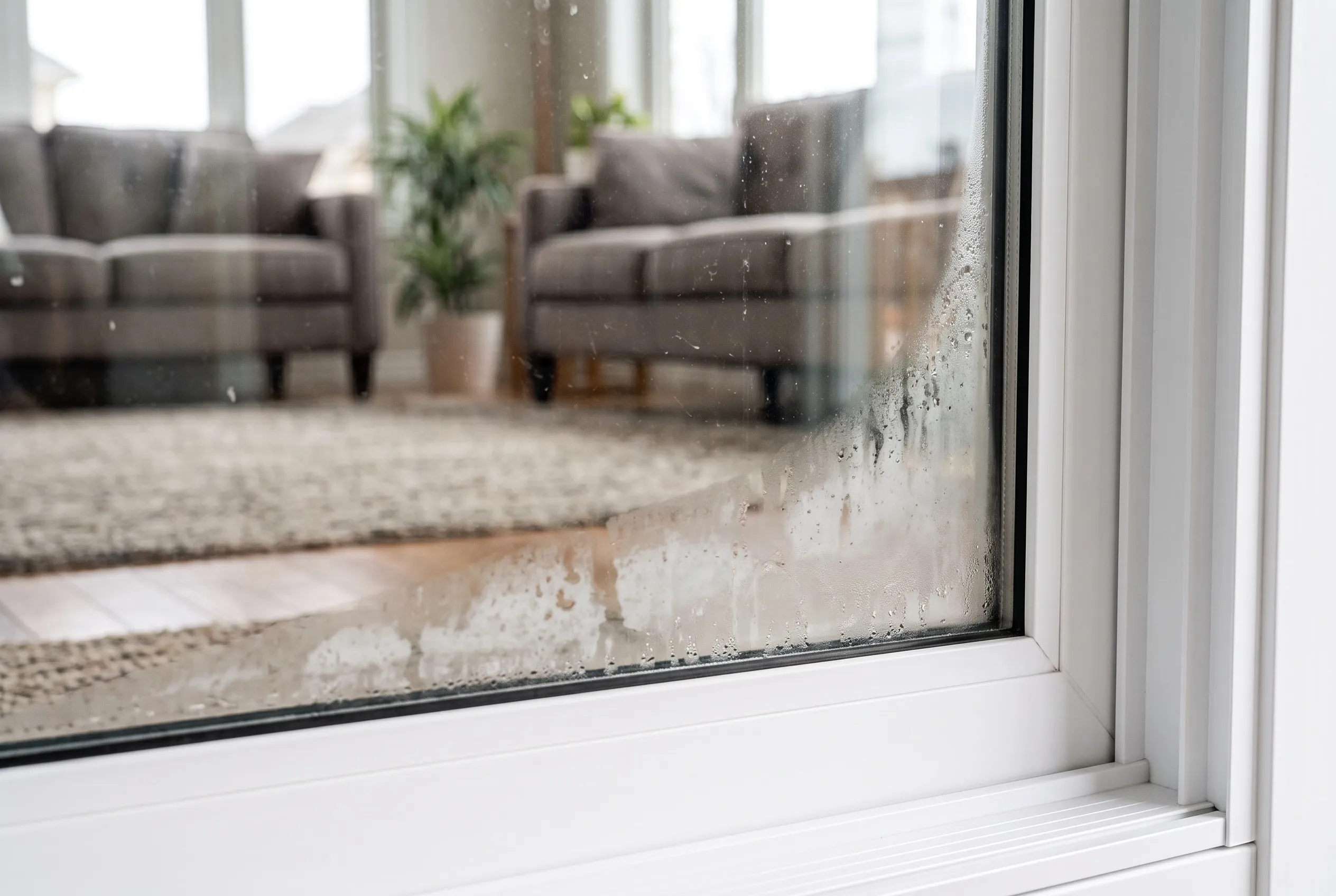
Foggy glass between the panes is usually a repair, and it is often a glass or panel question, not a whole-door question. The haze you cannot wipe off is moisture that got past a failed seal into the space between the panes. A large slider panel is a sealed insulated glass unit, the same construction as a window, so when the seal fails the unit loses the inert gas fill that gave it its rated performance. The National Fenestration Rating Council rates that performance, U-factor and air leakage, on the label (NFRC).
The seal physics are identical to a fogged window sash, so rather than repeat them we explain the full mechanism in our guide to window problems in older Greater Malden homes. The patio-specific part: because slider panels are large glass units, a fogged panel often points to swapping the glass unit or the panel, not the whole door, provided the frame and track are sound. Paired with a rotted sill or a racked frame, the call changes, and we cover that below.
Why is there a cold draft coming off my patio door?
A cold draft along the edge of a slider is a repair in the large majority of cases. The usual causes are a worn weatherstrip, a failed sweep at the bottom of the panel, or a brush seal that has packed down flat. All three are serviceable parts. The Department of Energy is direct: for a sound door, weatherstripping and sealing to cut air leakage is the cost-effective step before replacement (DOE Energy Saver, archived June 2026). Air leakage is one of the things NFRC rates on the label.
One note for homes near the water. On coastal-exposed Revere properties we see more corroded rollers, seized locks, and salt-degraded seals, because salt air is hard on hardware and weatherstrip. It looks alarming, but it is still a hardware-and-seal repair in most cases, covered in our note on window repair in Revere, MA. Weighing the energy side of a newer door? Our energy-efficient patio doors for New England page walks the specs.
My patio door lock or handle is broken, or the door doesn’t latch. Is that fixable?
Yes, in nearly every case. The lock, latch, keeper, and handle on a slider are serviceable parts, and replacing a failed lock or handle is a straightforward repair. Often the door only feels like the lock is broken. What actually happened is the panel dropped on worn rollers and pulled the latch out of line with the keeper. Re-align the keeper, or reset the panel height, and the door latches like new.
The only time a lock problem points toward replacement is when it is secondary to a frame racked so far out of square that nothing lines up. That is the sill-and-frame issue below, and we diagnose it as one.
When is rot in the sill or jamb a replacement, not a repair?
This is the one symptom that regularly points to replacement rather than repair. Not all rot is equal. Shallow surface rot on a piece of exterior trim can sometimes be cut out and patched by a carpenter. Rot in the sill, threshold, or jamb is a different matter: the Department of Energy treats rotting frames as a structural problem and a reason to replace, not a cosmetic patch (DOE Energy Saver, archived June 2026). What moves a door past repair is exactly that structural rot, soft and deep into the sill, jamb, or frame, or a frame racked out of square. Setting a new panel into that opening wastes it, because the opening is what failed.
Across the older Greater Malden homes we survey, the sliders that reach this point are overwhelmingly original 1960s to 1980s aluminum and early vinyl units on additions, porches, and walk-out levels of two-families and ranches. Those openings took decades of weather at grade, which is where sill rot and racking start. When we find it, we say so in writing rather than talk you into a repair that will not hold. If the verdict is replace, our patio door replacement cost guide for Massachusetts gives you the ballpark, and the patio door installation hub for Malden covers the install.
What New Sash checks before we quote a sliding patio door
Before a number goes on the page, we do a free visit and leave a written diagnosis. On a sliding patio door we check, one opening at a time: the rollers and track, the panel’s square in the frame, the glass seal on each panel, the weatherstrip and sweep, the lock and keeper alignment, and the sill and jamb for rot. On older homes we probe the sill rather than eyeball it, because paint hides soft wood. Each opening comes back as one line: repair, replace, or depends.
The same factory-trained crew handles both repair and installation, so there is no incentive to push the bigger number when a repair will do. We work with sliding, French (hinged), and multi-slide or telescoping patio doors, and we repair and replace existing patio doors. The price you take home is the price you pay. As one Google reviewer put it: “The quality and service were first rate, and the price was as quoted. No surprises.” (Steve Brickman, Google review, 2026-05). See the full list on our services page.
Frequently asked questions
Can a foggy patio door be fixed without replacing the whole door?
Often, yes. A fog you cannot wipe off means the sealed glass unit failed and lost its gas fill, which NFRC rates on the label (NFRC). Because those panels are sealed units like windows, the fix is often a glass or panel swap, not a new door, if the frame and track are sound.
My slider is hard to open. Does that mean I need a new door?
Almost never on its own. The usual cause is a dirty track or worn rollers: a clean, adjust, or roller swap. The Department of Energy favors servicing a sound unit before replacing it (DOE Energy Saver, archived June 2026). We only reconsider if the frame has dropped out of square.
How do I know if my patio door sill rot is repairable?
The test is depth. Shallow surface rot on exterior trim can sometimes be cut out and patched, but the Department of Energy treats rot in the sill or frame as a structural problem and a reason to replace, not a cosmetic one (DOE Energy Saver, archived June 2026). Rot that is soft and deep into the sill, jamb, or frame points to replacement. We probe rather than eyeball on older homes.
Do you repair patio door locks and rollers, or only replace whole doors?
We do both. Locks, handles, keepers, rollers, tracks, weatherstrip, and sweeps are all serviceable parts we repair. Window and door repair is one of our core services, alongside patio door installation. We work on sliding, French, and multi-slide patio doors, and recommend a full replacement only when the sill or frame has failed.
Not sure if it is a repair or a replacement? Get a free written diagnosis
Your slider is doing one specific thing, dragging, fogging, drafting, jumping the track, or not latching, and that one symptom usually has a clear answer. Get a free written diagnosis and we will tell you which it is. We repair and replace sliding, French, and multi-slide patio doors across Malden and the Greater Malden area (Medford, Melrose, Everett, and Revere), and we tell you the repair option before the replacement option, in writing. Winter installs are routine, so a failing door does not have to wait for spring.
Call (833) 639-7274, email info@newsash.com, or request your free written diagnosis. We respond within 24 hours with no high-pressure visit. You can also reach us at 15 Waite Ct., Malden, MA 02148.